what to look for in first electric guitar
Which Guitar Should I Buy? Beginner'due south Electric Guitar Guide
With so many electrical guitars on the market, it tin exist tricky to know where to get-go when looking to buy your next guitar. This buying guide aims to help you option the right electric guitar for you…
The right electric guitar for you is the one that suits your musical style and has the right features to achieve that sound. We'll interruption down all the factors you may wish to consider when buying an electric guitar.
The get-go thing to note is, just similar your favourite food, pair of shoes, car, bicycle, or movie; in that location's no one "perfect" guitar – many instruments can be made to do different things in different players' hands. But, if you can narrow downwards on the specific features you call back you'd adopt, you tin see which guitars volition match your requirements and get the most suitable choice for you. This guide aims to assistance you lot do that.


The Basics
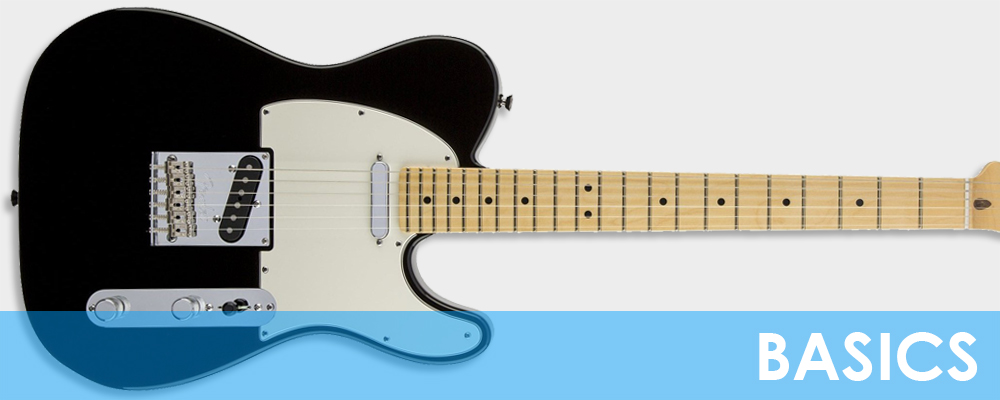
What'due south my budget?
Electric guitars come at a huge range of prices, from sub-£100 to well over £2k. When choosing your first guitar, i of the nearly important factors is deciding on your budget.
Spending more coin will generally upshot in amend woods, ameliorate hardware, better setups, and a more recognisable brand – upwardly to a point. The law of diminishing returns means that, equally you begin to spend a lot more money, the improvements will get less obvious for the aforementioned increase in price – i.e. information technology's not always the case that a £4k guitar (maybe a vintage model) is twice as good as a £2k guitar.
Fortunately, this ways that the more money you spend on a guitar at the lower-end of the price spectrum, the more noticeable the improvements will be.
You lot should likewise gene in the price of buying an amplifier, which will vary in price depending on how loud yous wish to play (silent, habitation use, do, small-scale rehearsals, or full gig volume) and how many boosted features you need (headphone output, silent exercise mode, AUX-in, Bluetooth etc).
Of class, you don'thave to buy an amplifier to become started; in that location are many peachy iOS apps which will permit yous hear your guitar when used with a special interface. Some players simply showtime playing guitar without an amp altogether – it'south perfectly fine for getting the basics downward!
Some of our guitar packs feature everything you demand to get playing including a guitar, amplifier, and cables; they remove the worry of putting together a guitar rig. If you do make up one's mind on a guitar package, yet, you'll still need to know the blazon of guitar you'd like to buy, so go along reading!
Are aesthetic of import?
The aesthetics of your guitar play a huge part when deciding which instrument you should purchase. If you have a favourite guitarist who you lot'd similar to sound like, a bang-up starting point is to see what guitars they play and try and friction match that with the instruments you lot're looking at. This is analmost sure-fire style of getting an instrument that will sound right for the type of music you lot adopt.
Going beyond the basics of budget and looks, at that place's some cardinal guitar terms you may wish to consider when buying your first guitar.
Body
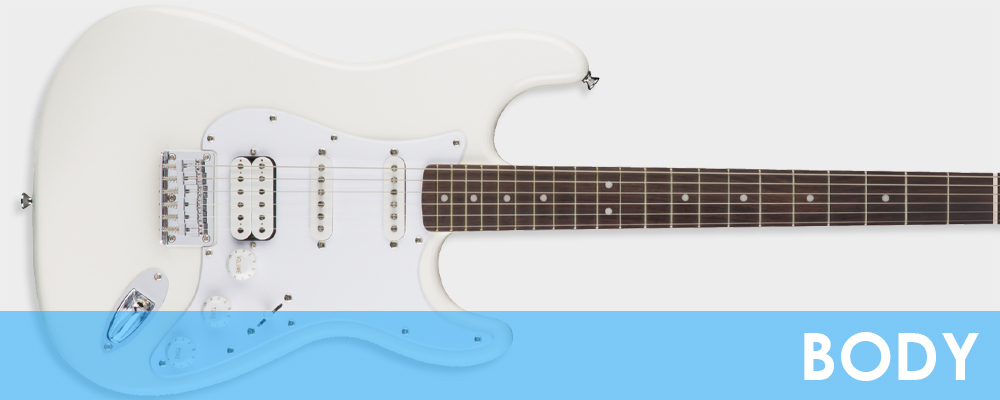
Torso Way
Electric guitars come in two body types – solid body andhollow body. Solid body guitars are constructed from solid blocks of woods and are seen as the 'standard' electrical guitar. Hollow body guitars can either be semi-hollow (with a tone block within) or completely hollow.
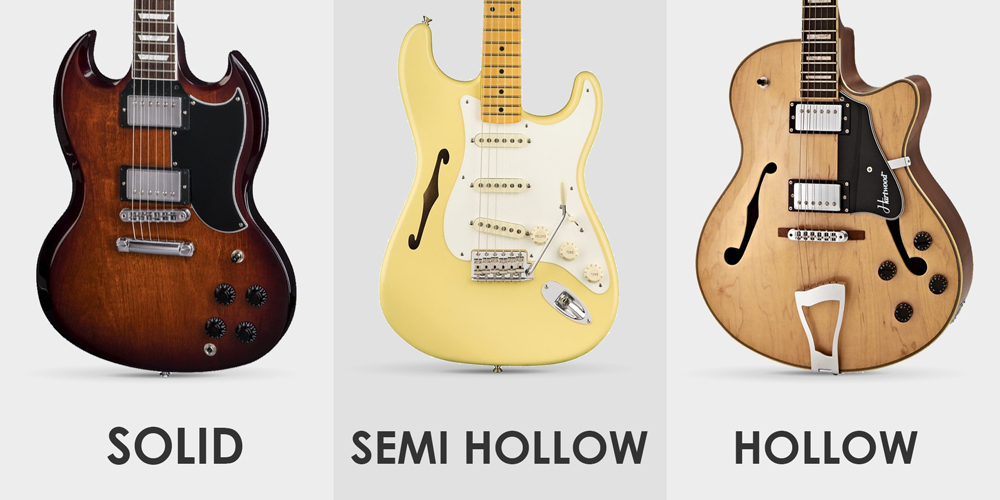
Solid body guitars are the most versatile guitars of all, beingness capable of playing in all styles of music. The solid torso design makes the tone more focussed and less prone to feedback. With a elementary change of hardware and tonewoods, these guitars can be honed for any style of music imaginable.
Semi-hollow body guitars have a more lively, 'audio-visual' tone and increased resonance. This comes at the expense of tonal focus.Semi-hollow guitars are more than versatile and can cover both clean and overdriven sounds. Semi-hollow instruments have been seen in many genres including jazz, pop, funk, soul, dejection, stone, indie, alt-stone, and even rock (think Malcom Young from AC/DC, or Dave Grohl from Foo Fighters).
Completelyhollow trunk guitars have larger bodies and have the most resonant 'acoustic tone'; they are commonly seen in jazz, where a thick make clean tone with dandy resonance is required. While completelyhollow guitars are perfect for traditional jazz, they are non ideal for high-proceeds styles of music, such as rock or metal.
If you lot're going for your get-go electrical guitar, asolid trunk musical instrument is by and large seen as the mutual 'standard' pick. However, if your favourite players use semi-hollow or hollow-body guitars, there's no reason why y'all shouldn't start with one too if you lot wish to emulate his/her sound!
Tonewoods
The more expensive the guitar, the more probable the torso will be constructed from a solid tonewood rather than a laminate. This influences the quality of the sound and the guitar's resonance.
The neck usually consists of a separate wood to the fingerboard, equally the fingerboard needs to be a harder wood for durability.
Different tonewoods influence the sound of the musical instrument and sometimes a layering of wood is used to blend the tonal qualities of both. While the full discussion of tonewoods could occupy an entire article on its ain, here's a few of the key options:
- Mahogany – warm, resonant, skilful sustain, good midrange. Commonly used for stone guitars and seen on the neck and body.Similar to koa, korina.
- Maple – bright audio, good 'attack' (fast annotation sounds for make clean funky playing). Commonly used for versatile guitars in rock, blues, indie, country. A common wood for all parts of the guitar (fingerboard/cervix/body).Like to pine, poplar, paulownia, ash.
- Basswood – lightweight with a balanced tonality. Commonly used for bodies on versatile guitars in rock and metallic.Similar to alder, poplar.
- Rosewood– a common fingerboard wood. Dark coloured and 'tight' joint of notes with a shine feel. Now generally phased out of use due to ecology restrictions.
Shape
The shape of the body tin can influence the manner the guitar feels to play. The 'horns' of the guitar are the most defining features of standard guitar bodies and help categorise the body shape.
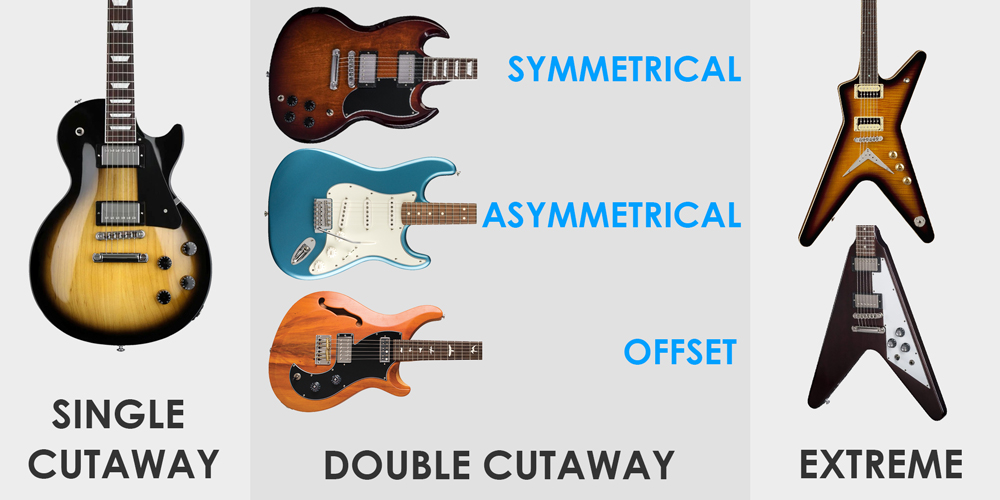
A twin-horned guitar is labelled with a'double cutaway': the twin horns make information technology like shooting fish in a barrel to admission the top of the fingerboard. The double cutaway pattern may besymmetrical,asymmetrical, oroffset: where i half of the trunk has been shifted off-centre. These guitars offer excellent condolement and ease of access to all the frets.
A single-horned guitar is labelled as a'single cutaway': this design makes it slightly less easy to access the summit of the fingerboard for loftier-range solo techniques. All the same, many guitar designs solve this with low-contour cervix joints and sculpted horns.
V-shape guitars andextreme torso shape guitars are an entity unto themselves! Perfect for those looking to stand up out from the crowd but non as ideal when played sat-downward.
Neck
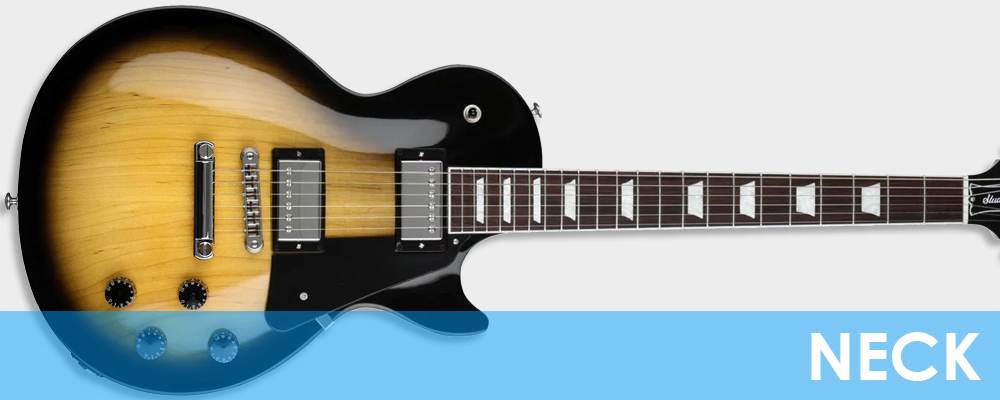
The neck of the guitar influences the playability of the instrument – small specification changes can actually add up to create a very different playing experience. For beginners, this will be less noticeable every bit you lot'll accept no previous starting bespeak, only there a few specifications to spotter out for.
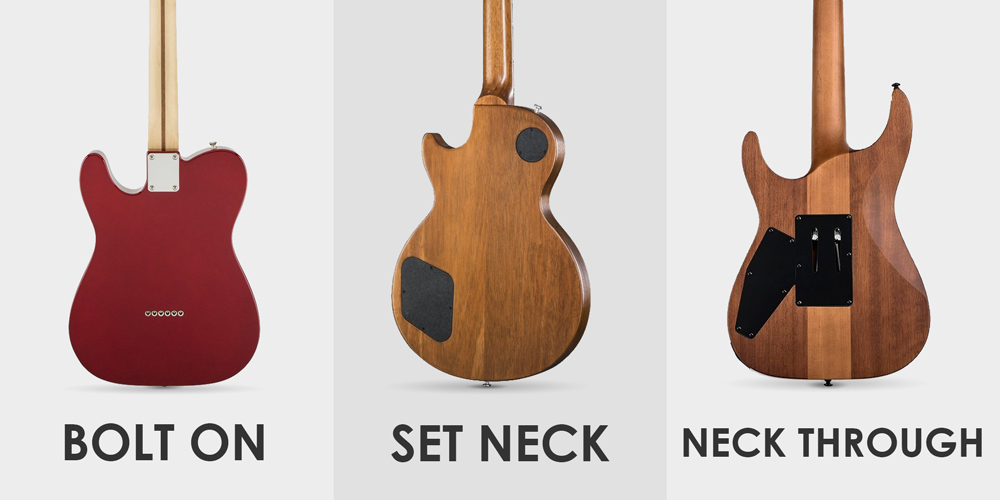
Cervix joint
The neck is joined to the body with bolts (commodities-on) or glue (gear up-neck). Each guitar style has its ain slightly different sound.
Bolt-on guitars are generally brighter, whereasset-neck guitars have a warmer tone with more resonance. Each guitar mode has a slightly dissimilar feel – try them out in person, if you tin, to see which y'all prefer!
In general, the bolt-on guitar fashion is especially popular with Fender guitars and with other solid torso guitars built for high-speed playing. The gear up-cervix guitar is popular with Gibson, and features on solid body guitars built for rock/blues/metal, and hollow guitars built for jazz/blues/soul.
The alternativeneck-throughconstruction consists of a unmarried cervix block running the entire length of the guitar. Ii trunk 'wings' are fastened on either side to make the complete body shape. These guitars are rarer but incredibly smooth to play, with no neck-joint to hinder upper-fret access. They also take enhanced sustain and resonance.
Number and size of frets
Want to play the fastest, most high-octane playing styles with the widest note range? Chances are you lot'll want 24 frets. This is the common maximum number of frets on an electric guitar. 22 is seen as a 'standard' number of frets – perfect for soloing and rhythm work – while 21 frets (sometimes xx) is the 'vintage' mode.
Generally, the bigger the frets, the easier you'll find cord bends and vibratos (2 soloing techniques). The downside with 'jumbo' frets is y'all may push too hard and bend the string out of tune.
Smaller fret sizes offer the remainder between easy solo techniques and a smoothen glide over the strings when traversing the fingerboard. Vintage guitars often had pocket-sized frets – great for chords but catchy when getting a skillful 'grip' on the strings for modern solo techniques. A 'medium' size fret, sometimes 'medium jumbo' is seen as the standard.
Calibration length, radius, and neck profile
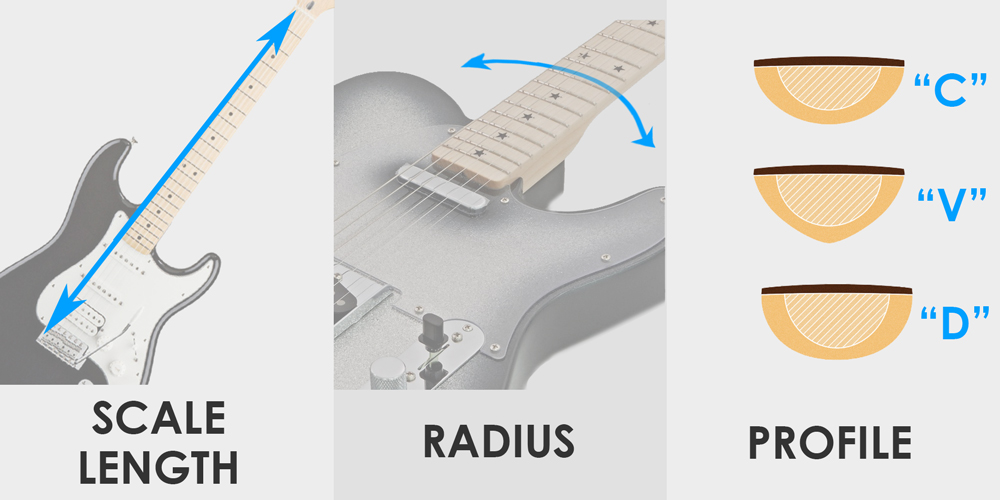
- Scale length: The length of the strings from the nut (at the top of the cervix) to the bridge (on the body). A longer scale length gives the guitar more resonance (think the sound of Fender guitars) merely make string bends harder, as in that location is more tension. Shorter scale lengths make string bends and solo techniques slightly easier, as there is less tension and the frets are slightly closer together.
Sometimes longer scale lengths are used to create a better guitar for low tunings, used in rock/metal music.
-
- 24" and under: short calibration length
- 25" and over: longer scale length
- Fingerboard radius: The fingerboard of the guitar is crafted with a gentle curve – imagine the surface of a cylindrical pipe. The bigger the radius, the flatter the curve will be, and the easier you'll find it crossing the strings for fast soloing techniques.
Smaller radiuses have a bigger curve and are traditionally chosen for easier chord playing.
-
- seven-9": vintage size. Smashing for chord playing. Less good for soloing and cord bends every bit the strings may 'choke' out as they catch the other frets during bigger bends.
- 9"-12": standard modernistic sizes for the perfect balance between chord playing and solo work.
- 12" : a very flat fingerboard for mod playing styles. Great for soloing and providing balance across the strings.
- Neck profile: this is the actual shape of the cervix, as it sits in your mitt. 'C'-shaped necks are generally more standard, with a chunky experience in the hand, while 'D'-shaped necks are slimmer and more popular with high-octane rockers.
Pickups & configurations
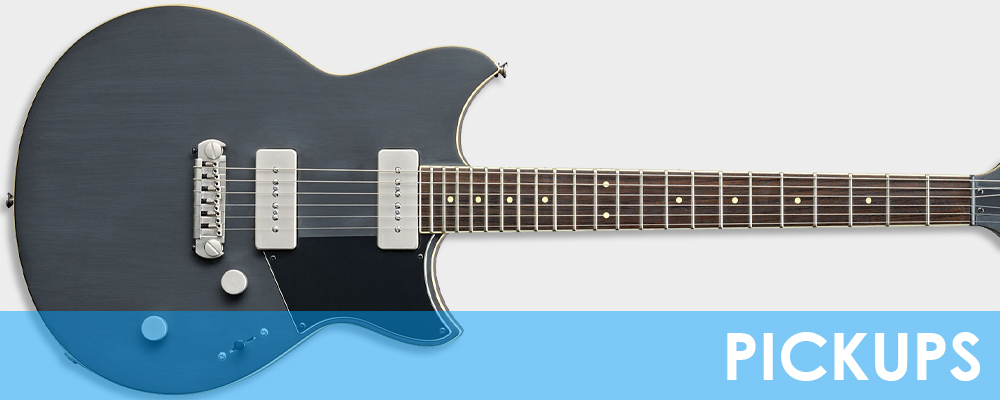
The pickups are loaded to the front of the guitar nether the strings. They are fabricated from magnets wrapped in coils of wire and catechumen the strings' vibrations into electric signals to exist amplified. Pickups have ahuge influence on the overall tone of the guitar and come in dissimilar types and configurations on the guitar.
Pickup types
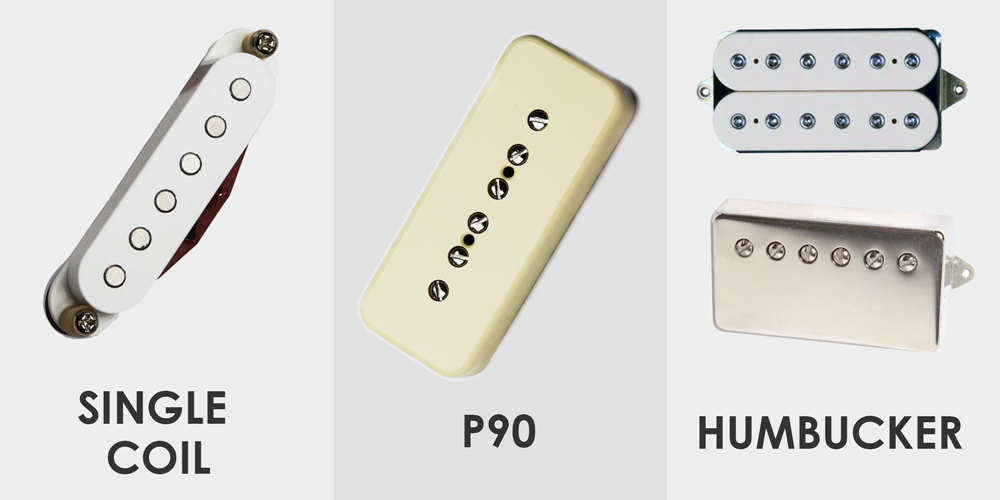
- Unmarried Gyre: more often than not, a lower-powered option with a brighter and more nuanced tone. Think of the sounds of Biffy Clyro, Mark Knopler from Dire Straits, or Bruno Mars with his songUptown Funk.They are very versatile pickups and are corking for popular, blues, soul, funk, rock and country.
Unmarried coils have an inherent background 'hum' due to the nature of their blueprint (more than noticeable under lighting and near computer monitors) – don't worry, though; many great guitarists accept used them over the decades.
- P90: a vintage-style pickup with a 'half-way' tone between single-coils and humbuckers. They have the nuance and brightness of a single-coil with some of the 'seize with teeth' of a humbucker – a very versatile choice!
- Humbucker: a more powerful pickup with two coils mounted back-to-dorsum. They are perfect for blues, rock and metal. The dual-coil design is dissonance-cancelling: the humbucker literally 'bucks' the groundwork 'hum' plant in unmarried-coil pickups.
- Active: some of the guitars you'll see have a 9V bombardment and are labelled with 'active pickups'. This simply means the pickups have additional power and a stronger sound – ideal for rock and metal.
Pickup configurations
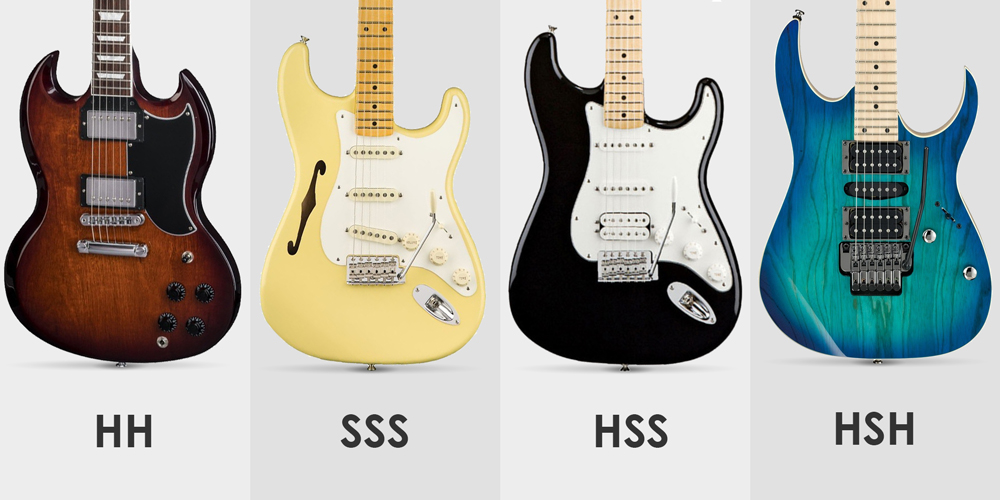
- HH – twin humbuckers with a powerful sound that is perfect for rock and metal.
- SSS– 3 single coils with a balanced and nuanced tone. Dandy versatility as they ordinarily accept a v-style switch to select 5 different sounds from the guitar.
- HSS– a humbucker for powerful rock tones, combined with ii single-ringlet pickups for nuanced lower-proceeds sounds: a very versatile range of sounds that can cover about all genres.
- HSH – ordinarily seen on 'shred' guitars designed for speed and high-octane playing. A very versatile pickup configuration that blends the all-time of humbucker and single-coil tones.
Bridge
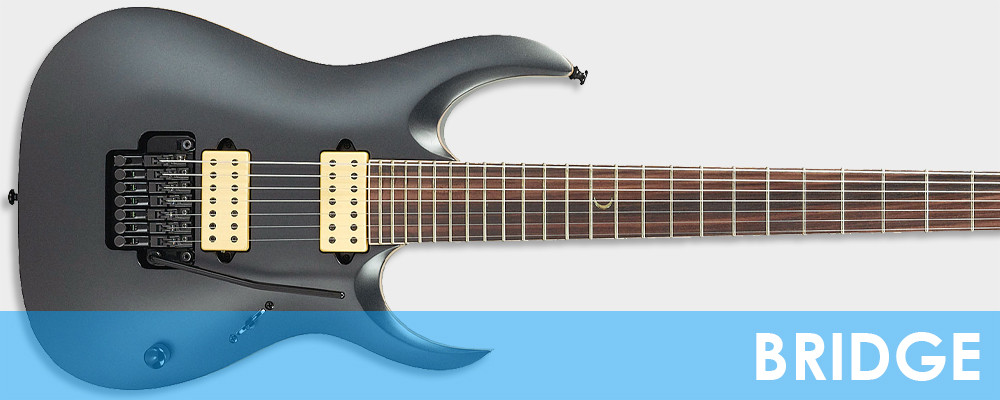
The bridge is the where the strings connect with the guitar. While the standard bridge is stock-still with no move, some guitars have a tremolo system which allows you to manipulate the pitch of the strings using the "whammy bar". Dissimilar bridges and tremolo systems feature adjustment points for theactivityandintonationof the guitar (2 topics beyond the scope of this article!)
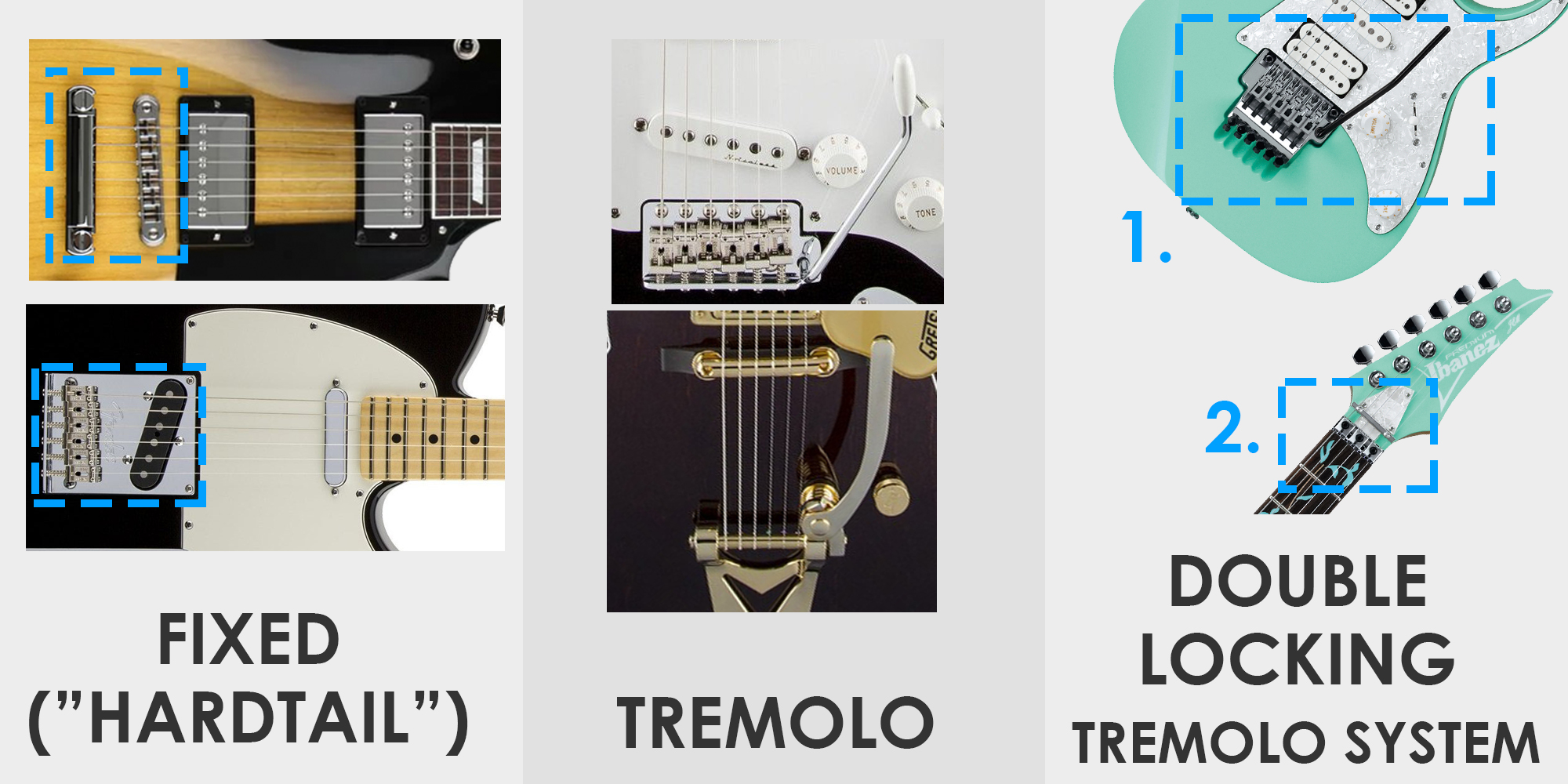
- Fixed bridge: no span movement. It generally has better sustain and tuning stability.
- Vintage-Fashion Tremolo: a moving bridge with a "whammy" bar letting yous accommodate the pitch of all 6 strings at once. These guitars crave tuning more oftentimes, as use of the tremolo over fourth dimension will affect the guitar's pitch.
- Double Locking Tremolo – the double locking tremolo (like the Floyd Rose brand) features a moving tremolo as above, but the strings are "locked" in place in ii places on the guitar, so cannot slip during whammy bar use.
This means you tin can perform some truly farthermost whammy bar tricks (remember ofDragonforce, Steve VaiorVan Halenwith their 'extreme' furnishings) and not worry about going out of melody. The downside of locking tremolos is the setup and maintenance required, not to mention the added difficulty of changing strings.
Discover out more
Now that you're all clued up on finding the perfect electrical guitar for you, why non explore our full guitar range?
Store now | Electric Guitars
boltonyousterromme.blogspot.com
Source: https://www.gear4music.com/blog/which-guitar-should-i-buy-beginners-electric-guitar-guide/
0 Response to "what to look for in first electric guitar"
Publicar un comentario