what is the name of the parts to make a semi trailer box
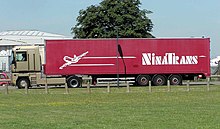

A truck pulling a semitrailer using a trailer dolly
A semi-trailer is a trailer without a front end axle. In the United States, the term is also used to refer to the combination of a truck and a semi-trailer; a tractor-trailer.[1]
A large proportion of a semi-trailer's weight is supported by a tractor unit, or a detachable front-axle assembly known as a dolly, or the tail of another trailer. The other portion of the semi-trailer'southward weight is semi-supported (one-half-supported) by its ain wheels, which only back up the rear of the semi-trailer.[ii] [3] [4] [five] A semi-trailer is normally equipped with landing gear (legs which tin can be lowered) to support information technology when it is uncoupled. Many semi-trailers accept wheels that are capable of being totally dismounted and are besides relocatable[6] (repositionable) to better distribute load to bearing wheel weight factors.[seven] Semi-trailers are more popular for transport than full trailers, which have both front end and rear axles. Ease of backing is cited as one of the semi'due south primary advantages. A road tractor coupled to a semi-trailer is oft called a semi-trailer truck or "semi" in North America & Commonwealth of australia, and an articulated lorry or "artic" in the Great britain.
Semi-trailers with two trailer units are chosen B-doubles (Australian English) or tandem tractor-trailers,[8] tandem rigs, or doubles (American English). Other terms used are "B-railroad train" or (when there are three or more trailers) "route train". A double-trailer combination is possible with the apply of a dolly, or "converter dolly" (Australian and American English), essentially one to iii additional axles placed under the forepart of a 2nd semi-trailer. The first semi-trailer is connected to the ability unit using the tractor'south fifth cycle coupling while the converter dolly, already attached to the 2nd semi-trailer, is connected to the first semi-trailer with a drawbar. In Australian English language, the tractor unit is called a "prime-mover", and the combination of a prime number-mover and trailer is known as a "semi-trailer", "semi" or single.
Properties [edit]

A 1920 advertisement for semi-trailers
Semi-trailers were invented by August Fruehauf in 1914.
Road tractors and semi-trailers are responsible for conveying a large proportion of cargo. With one,170,117 million tonne-kilometers transported this way in the European Union, including the UK, road tractors and semi-trailers are 77.vi% of the total tonne-kilometers transported in 2015, co-ordinate to Eurostat.[nine]
In road haulage, semi-trailers predominate over full trailers because of their flexibility. The trailers can be coupled and uncoupled chop-chop, allowing them to be shunted for loading and to exist trucked between depots. If a power unit of measurement fails, another tractor can replace it without disturbing the cargo.
Compared with a full trailer, a semi-trailer fastened to a tractor unit of measurement is easier to reverse, since it has only i turning point (the coupling), whereas a total trailer has two turning points (the coupling and the drawbar attachment). Special tractors are known as shunt trucks or shuttle trucks can easily maneuver semi-trailers at a depot or loading and unloading ferries. These tractors may elevator the coupling and then the trailer legs articulate the ground.
A rigid truck and full trailer are articulated inside the cargo expanse length, so a semi-trailer can take a longer continuous cargo area. Because of this, a semi-trailer can booty longer objects, (logs, pipe, beams, railway track). This depends on the legislation; in some European countries, a full trailer can exist as long as a semi-trailer. However, since a rigid truck is longer than a semi-tractor, this increases the overall length of the combination, making it less maneuverable.
For heavy haulage or for increased manoeuvrability, some semi-trailers are fitted with rear-wheel steering, controlled electro-hydraulically. The wheels on all or some of the rear axles may be turned through unlike angles to enable tighter cornering, or through the same angle (so-called 'crab' steering) to move the rear of the trailer laterally.
Couplings [edit]
The two types of couplings are 5th wheel coupling and automatic. In some applications, no separable coupling is fitted, and the trailer is bolted to the tractor unit, using a bearing, and rocker feet every bit are used under a fifth wheel sideslip plate.
Fifth cycle coupling [edit]
The towing vehicle has a wide coupling plate known as a fifth wheel coupling bolted onto its chassis on which the semi-trailer rests and pivots. As the tractor reverses under the trailer, a kingpin under the front of the trailer slides into a slot in the skid plate, and the jaws of the fifth bike shut onto information technology. The driver has to raise the trailer legs manually, and couple the airbrake lines and electric cables. Some low-set trailers such as lowboys/low-loaders and motorcar transporters have electrically-powered landing gear due to the necessarily low clearance prohibiting conventional landing gear.
Automatic couplings [edit]
Many years ago, automated couplings predominated,[ citation needed ] but have not been used now for around fifty years. Automatic couplings were more often than not used for payloads of 12 short tons (x.7 long tons; 10.9 t) or less, e.g. on the Scammell Mechanical Horse.The Scammell coupler was initially very pop and fitted to many other makes of truck
No coupling plate is used on the tractor; a turntable is permanently fixed to the underside of the trailer. This locks to the chassis of the tractor. When the tractor reverses under the trailer, its legs ascension and the restriction and electrical connections are fabricated automatically. Almost the unabridged coupling and uncoupling process is operated by the driver from inside the cab, except that he or she has to descend to release (or apply) the trailer parking brake.[ commendation needed ]
Types [edit]
Dissimilar types of semi-trailers are designed to haul different cargoes.
Common widths are 8 ft (two.44 grand),[10] and 2.6 metres (102.36 in).[11] Generally speaking, almost Due north American type trailers apply two axles with dual-tire hubs totaling 8 wheels, while most European type trailers use three axles with single-tire hubs totaling 6 wheels, with one of the axles being able to be lifted for lighter loads and saving on tire, restriction, and axle clothing. Nearly all sufficiently tall modernistic trailers are equipped with a rear underride baby-sit to prevent cars from passing across the rear edge of the trailer, and about also have side underride guards for the same reason. In that location are as well other smaller differences with regards to kingpin depth, lighting, door locks, et cetera, though most purpose-built tractor trucks tin carry well-nigh types of trailer regardless of which continent it was built on and the differences therein.
- Box or van trailers are the nigh common type. They are quite merely a metallic box on wheels with some doors on the back, though some offering additional access doors on the sides. Standard lengths in North America are 28 ft 0 in (8.53 yard), 32 ft 0 in (9.75 m), 34 ft 0 in (10.36 yard), 36 ft 0 in (10.97 m), forty ft 0 in (12.19 thousand), 45 ft 0 in (thirteen.72 m), 48 ft 0 in (xiv.63 grand), 53 ft 0 in (sixteen.15 m) and 57 ft 0 in (17.37 m).[11] Due to maximum length regulations and the need to maximize cargo inside said regulations, virtually all European semi-trailers are 13.lx grand (44 ft 7+ vii⁄sixteen in) in length.
- Bus-bodied trailers are hitched to a tractor unit of measurement to class a trailer bus, a simple alternative to edifice a rigid motorcoach.
- Machine carrier trailers carry multiple cars, commonly new cars from the manufacturer. In the US and elsewhere, machine carriers frequently carry used vehicles besides. Like variants can carry forklift trucks, calorie-free commercial vehicles, and agricultural tractors. Single-deck versions are used for larger vehicles.
- Conestoga trailers are a special form of a flatbed trailer with a flexible retractable roof and siding used to carry large pieces of equipment that can merely be lifted by an overhead crane, simply which also need protection from the weather during transit.
- Drape siders or tautliners are similar to box trailers except the sides are movable curtains made of reinforced fabric coated with a waterproof coating. To put it another style, it is basically a flatbed trailer with additional aerodynamic and weather protection as well as greater load security. They generally have a restraining organization of straps and buckles every foot (30 cm) or so to keep the curtain tight and adverse to the elements. As well, some have removable gates mounted into the trailer, to assistance reinforce the load and prevent bulges. The purpose of a curtain sider is to combine the security and weather resistance of a box trailer with the ease of loading of a flatbed. Mantle siders are one of the about common trailer types in Europe.
- Drop-deck trailers (or stride-frame trailer) have a floor that drops down a level once clear of the tractor unit; the near mutual types of drop-deck trailers are flatbeds and mantle siders.
- Double deckers or deckers have either a fixed, hinged, or moveable second floor to enable them to carry more than palletized goods. In general, a double-decker tin carry 40 pallets, every bit opposed to 26 for a standard trailer. Double-deck trailers are generally a step-frame construction with the bulk being either box or drapery siders, with box trailers having either a fixed or movable (floating) deck, and drapery sides having either a fixed or hinged second deck; this hinged second deck generally swings into a position downwardly the length of the trailer and can be divided into two or iii sections to allow greater load flexibility. In Australia and New Zealand, they are known every bit mezzanine trailers or mezz-decks for short.
- Dry out bulk ("British" powder tankers) trailers resemble large tankers but are used for cement, sand, barite, flour, and other dry powder materials.
- Dump trailers ("British" Tippers) are trailers in which one end tin be raised to allow the cargo (often building materials or Agricultural produce) to slide out the other end. Commonly, they are hinged at the rear and raised at the front, but side-unloading dump trailers also are used.
- Flatbeds, or flat decks, consist of merely a load flooring and removable side rail and a bulkhead in front end to protect the tractor in the event of a load shift. They can haul almost anything that tin be stacked on and strapped downwardly.
- Hopper bottoms are usually used to haul grain, only can exist used to haul other materials.
- Inloaders are used to transport drinking glass panes on stillages. They characteristic an open up lesser to maximize loading peak and the unabridged trailer can be lifted and lowered during loading, to allow safety loading of fragile glass panels.[12]
- Intermodal trailers are similar in frame design to box trailers, but without whatsoever sort of integral cargo-carrying ability equally they are designed to carry a diverseness of standard Intermodal containers
- Live bottom trailers take a conveyor chugalug on the bottom of the trailer tub that pushes the load material out of the dorsum of the trailer. The tub does not have to be raised to deposit the materials.
- Livestock trailers are used to booty livestock such every bit cattle, horses, pigs, sheep, etc. Unremarkably, they have two levels (or three for hogs) to maximize capacity.
- Lowboy ("British/Australian" low-loader) trailers are a type of flatbed in which the load floor is every bit close to the ground as possible, most unremarkably used to haul heavy equipment, cranes, bulldozers, etc.
- Refrigerator trailers are box trailers with a heating/cooling unit (reefer) attached and insulated walls, used for hauling produce, frozen foods, meat, flowers, etc. Non quite every bit common but they are also produced in tautliner models with thicker curtains to sustain temperature.
- Fridge tank trailers are well insulated or refrigerated to haul bulk liquid foods, such as liquid carbohydrate, water, wine, milk or juices.
- Semi-trailers with sidelifters accept a hydraulic crane mounted at each end of the chassis assuasive for the loading and unloading of aircraft containers without the demand of a forklift or other container-handling equipment. Besides known as a Sideloader.
- Side bay trailers take a series of gyre-up or panel doors downward each side. Each door opens into individual compartments. These trailers are most normally used in the beverage distribution manufacture.
- Tank chassis or tank trailers are used for hauling liquids such as gasoline and alcohol, or various types of gases. They are like in principle to intermodal trailers but with a very dissimilar frame intended to exist fastened to a liquid or gas tank, hence the name. Some are designed with a lowered middle of gravity to ensure greater stability. Generally bottom loaded with the ability to recover whatsoever waste vapor for condom reasons.
- A "frac" tank trailer has a single and fixed axle, and is typically used during hydraulic fracturing at oil wells or for petrochemical industries. It is shaped like a wedge, and when it is unhitched, its bottom side lies flat on the ground.
- "Fly" trailers are mostly plant in Japan and are something of a hybrid between a curtain sider and a box trailer, with rigid, motorized Dupe-wing doors in place of the material curtains. Also institute as function of a rigid box truck.
Tank trailer [edit]
A tank trailer is a semi-trailer specifically designed to comport liquids, fluids and gases.[xiii]
Gallery [edit]
- Trailer types
-

Box trailer (US)
-

Curtain sider trailer (EU)
-

Semi dump trailer (EU)
-

Auto transporter (Brazil)
-
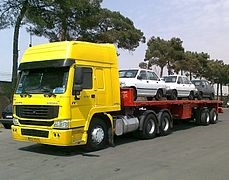
Flatbed trailer (Islamic republic of iran)
-

Alive lesser trailer (US)
-

Glass inloader trailer (Federal republic of germany)
-

-

-

-

Tank trailer (Nihon)
-

Gullwing trailer
-
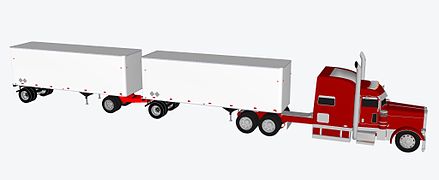
STAA double pup 28.5 foot trailers
-

Tank trailer
See also [edit]
- Air brake (road vehicle)
- Articulated lorries
- Articulated vehicle
- Brake
- Cargo
- 5th-bike coupling
- Fruehauf Corporation
- Gladhand connector
- Globe Trailers
- Trailer jack
- Jackknifing
- Live bottom trailer
- Long combination vehicle
- Refrigerated container
- Refrigerator truck
- Roll trailer
- Self unloading trailer
- Semi-trailer truck
- Shunt truck
- Side stake
- Swap body
- Tank chassis
- Teardrop trailer (truck)
- Trailer
- Trailer skirt
- Trailer tail
- Vehicle category
References [edit]
- ^ "Definition of SEMITRAILER". www.merriam-webster.com.
- ^ "Etymology - Why is it called a semi-truck? Doesn't "semi" mean "part"?".
- ^ "10 Things Yous Never Knew About Semitrucks". half-dozen Nov 2018.
- ^ "What is a Semi Truck?". 27 August 2019.
- ^ "Why are they called Semi-Trucks anyway?". 25 February 2015.
- ^ "Know how to slide your Tandems". www.bigtruckride.com.
- ^ "Positioning The Trailer Tandems - High Road Online CDL Grooming". www.truckingtruth.com.
- ^ "Transport & Machinery :: Route Send :: TRUCKING :: TANDEM TRACTOR TRAILER image - Visual Dictionary Online". visual.merriam-webster.com.
- ^ Eurostat (PDF)
- ^ "Whatsoever transport transportations from the Tandem-Trans ??? recheck the link". Tandem-Trans. Retrieved 2011-01-01 .
- ^ a b "Federal Size Regulations for Commercial Motor Vehicles". U.s.a. Section of Transportation, Federal Highway Administration. Retrieved 2011-01-01 .
- ^ FAYMONVILLE FloatMAX - the inloader for glass ship. Archived from the original on 2021-12-17.
- ^ Tank trailer
External links [edit]
-
 Media related to Semi-trailers at Wikimedia Commons
 - Semi trailers' manufacturers and sellers at Curlie
- ISO Standards Specific aspects for light and heavy commercial vehicles, busses and trailers
- Semitrailer dimensions
boltonyousterromme.blogspot.com
Source: https://en.wikipedia.org/wiki/Semi-trailer
0 Response to "what is the name of the parts to make a semi trailer box"
Publicar un comentario